
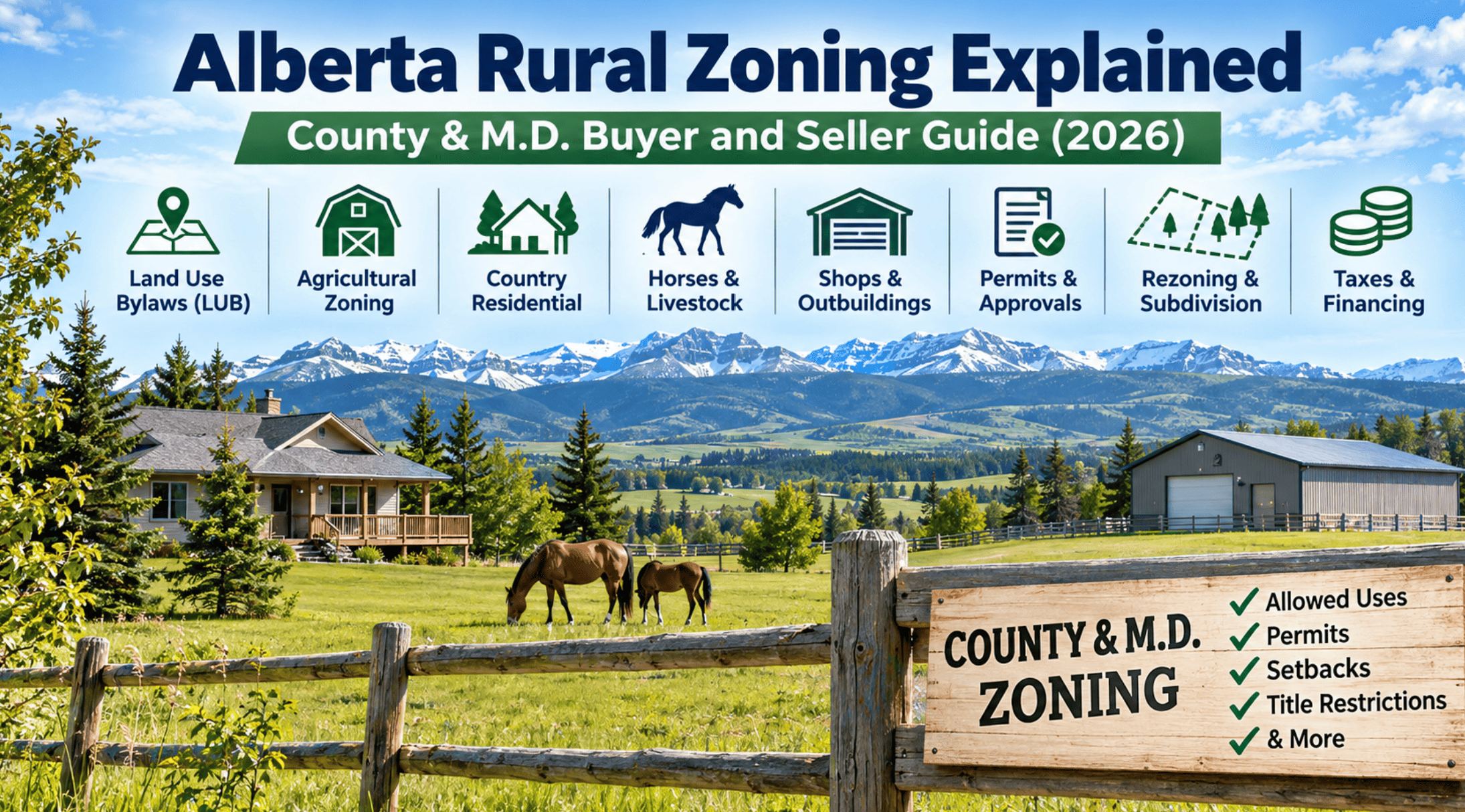
Alberta Rural Zoning Explained: County & M.D. Buyer and Seller Guide (2026)
Listing photos cannot tell you whether an acreage allows horses, a large shop, a second dwelling, a home business or future subdivision. Check the land use district and property-specific restrictions before committing to a purchase.
Alberta counties and municipal districts (M.D.s) regulate most local rural development under the provincial Municipal Government Act (MGA). The applicable Land Use Bylaw (LUB), statutory plans, provincial approvals and registered title instruments can all affect what you can do with a property.
Two properties of the same size can have very different development rights, servicing requirements, tax assessments and financing options. This guide explains how to investigate those differences before buying or selling an acreage, farm or ranch.
What This Guide Covers
- How Alberta Land Zoning Works
- Common Rural, Country Residential & Agricultural Zones
- R-RUR and Other Local Zoning Codes
- Direct Control Zones, Overlays & Title Covenants
- Permitted vs. Discretionary Uses & Development Permits
- Rezoning, Subdivision, Taxes & Financing
- Municipal Variations Across Alberta
- Key Checks for Buyers & Sellers
- County & M.D. Planning Contacts
- Horses, Shops, Water and Second Dwellings
- Provincial Rules vs. County Requirements
- Frequently Asked Questions
How Alberta Land Zoning Works
Zoning divides a municipality into land use districts, each setting out what uses are allowed, what permits are required, and what site standards apply (such as setbacks, building heights, parcel coverage, and parking). Under Alberta's Municipal Government Act (MGA), municipalities adopt Land Use Bylaws to regulate development and land use within their boundaries.
Hierarchy of Land Use Planning in Alberta
Rather than existing in isolation, a parcel's zoning sits inside a broader planning framework:
- Municipal Government Act (MGA): Provincial legislation establishing how municipalities plan, zone, subdivide, and issue permits.
- Provincial framework: The Alberta Land Stewardship Act, applicable regional plans and the Matters Related to Subdivision and Development Regulation establish additional planning requirements. See Alberta land use planning.
- Municipal and intermunicipal development plans (MDPs and IDPs): Policies guiding growth, agricultural land protection, servicing and planning across municipal boundaries, where applicable.
- Area Structure Plans (ASPs) & Area Redevelopment Plans: Localized plans providing more detailed land use and servicing direction for specific corridors, hamlets, or multi-lot areas.
- Land Use Bylaw (LUB) & Zoning Map: The legally binding rules and district boundaries applied to individual parcels.
- Project approvals: Development permits, subdivision approvals and safety codes permits serve different purposes. Provincial licences or other approvals may also be necessary.
Looking at a specific acreage, farm, or bare land parcel and unsure what the zoning allows? Call Diane Richardson at 403-397-3706 before you write an offer or list.
Common Rural, Country Residential & Agricultural Zones
Every county and M.D. uses its own district names and codes, so you should always read the exact bylaw text for the property. That said, rural classifications generally fall into three core groups:
Agricultural & Ranching Districts (Often A, AG, or RU)
Agricultural districts are designed primarily to protect farmland, crop production, grazing, and ranching operations. Typical features across rural municipalities include:
- Primary agricultural focus: Crop production, grazing and farming are common objectives. Minimum parcel sizes and subdivision policies vary by district and municipality; no universal acreage threshold applies.
- Residences and farm buildings: Dwellings and agricultural structures may be allowed, subject to the district, applicable exemptions and approval requirements. Additional dwellings require separate investigation.
- Subdivision & Non-Ag Uses: Splitting agricultural land is often tightly regulated to preserve contiguous farmland, and non-agricultural commercial or industrial uses may face stricter limits or discretionary review.
Country Residential Districts (Often CR or Rural Residential)
Country residential districts generally prioritize residential acreage living. Parcel sizes, livestock allowances and development standards depend on the specific local district and any applicable modifiers or title restrictions.
- Residential Lifestyle First: A single-detached home is the primary focus, paired with privacy, yard space, and rural scenery.
- Animals and shops: Check whether horses or other livestock are allowed, how animal units or usable land are calculated, and what setbacks and manure rules apply. Shops and garages may need development and building permits; exemptions and size limits vary.
- Home-Based Businesses: Many counties allow minor or major home-based businesses as permitted or discretionary uses, subject to traffic, parking, signage, and neighbour-impact rules.
Hamlet, Commercial & Industrial Districts
Rural municipalities also zone unincorporated hamlets (such as residential, commercial, or mixed hamlet districts) along with rural commercial, industrial, or business-park parcels for trades, storage, logistics, and local services. Servicing (private well/septic vs. communal or municipal water/wastewater) is a major factor in hamlets and commercial/industrial sites.
| Zoning Family | Primary Focus | Typical Watch-Outs |
|---|---|---|
| Country / Rural Residential | Acreage home living, privacy, limited hobby/livestock or home business | Animal caps, shop height/size limits, subdivision limits, HOA/covenants |
| Agricultural / Rural | Farming, ranching, crops, livestock, rural/agricultural land use | Strict subdivision rules, second-dwelling rules, ag vs. non-ag business limits |
| Hamlet & Specialty / Overlays | Hamlet lots, commercial/industrial sites, site-specific or hazard controls | Servicing limits, flood/environmental overlays, DC approval conditions |
R-RUR and Other Local Zoning Codes
Cities, towns and counties each administer their own land use bylaws. A rural-looking parcel inside city limits is not necessarily governed by county regulations. Confirm municipal boundaries rather than relying on a mailing address or listing description.
Rocky View County example: R-RUR means Residential, Rural District; R-CRD means Residential, Country Residential District; A-GEN means Agricultural, General District; and A-SML means Agricultural, Small Parcel District. These are local designations, not province-wide codes. Consult the Rocky View County Land Use Bylaw for the current rules and parcel-specific modifiers.
Direct Control Zones, Overlays & Title Covenants
Even when you know the base district, additional regulations and private restrictions can affect development:
- Direct Control (DC) districts: Site-specific rules adopted by council. Read the exact DC bylaw and confirm who decides applications; appeal rights may be limited under the MGA.
- Overlays and other constraints: Flood hazards, slopes, wetlands, riparian areas, highways, airports, pipelines and energy infrastructure may trigger additional requirements. Some arise from separate provincial or federal rules rather than a municipal overlay.
- Title instruments: Restrictive covenants, easements and caveats may affect development or use. Obtain the current title and copies of relevant registered instruments, and ask a real estate lawyer to interpret them. Municipal approval does not remove private restrictions.
Permitted vs. Discretionary Uses & Development Permits
Knowing a use is mentioned in a zoning district is only half the story. Land Use Bylaws divide uses into two main categories:
- Permitted uses: Where a development permit is required, a compliant permitted-use application must generally be approved under the applicable legislation. Separate safety codes permits may still be required. Confirm any exemptions before construction.
- Discretionary uses: Approval is not automatic. The development authority can approve with conditions or refuse an application. Notice and appeal requirements may apply; confirm when a permit becomes effective before starting work.
Rezoning, Subdivision, Taxes & Financing
Rezoning & Subdivision
Rezoning (redesignation) changes the applicable land use district through a council bylaw process. Applications may require fees, studies, referrals and public hearing procedures as applicable. Subdivision is a separate approval involving planning policies, access, servicing, parcel configuration and other requirements. Redesignation alone does not create a new legal lot. See our Foothills County subdivision guide.
Property Taxes & Rural Financing
Two common misconceptions trip up rural buyers:
- Taxes depend on assessment and use: Qualifying farmland is assessed using regulated agricultural productivity values. Qualifying farm buildings in rural Alberta may be exempt, while residences and other improvements can receive different assessment treatment. Agricultural zoning or keeping horses does not automatically qualify a property for farmland assessment. Ask the municipal assessor for the current breakdown.
- Financing depends on the lender and property: Acreage size, residential versus commercial use, income, condition, servicing and appraisal can influence eligibility and down payment requirements. Confirm financing for the specific parcel before removing conditions. See our Southern Alberta acreage financing guide.
Municipal Variations Across Alberta
Because each county, M.D., city, and town writes its own Land Use Bylaw, you cannot assume a zoning code means the same thing across a municipal border. Here is how rural and regional municipalities differ in focus:
- Foothills County: Balances agricultural and ranching protection, country residential acreages, hamlets, and foothills/mountain-access planning. See Foothills County property regulations.
- Rocky View County: Manages strong growth pressure next to Calgary alongside agricultural, small-holding, and country residential districts.
- Wheatland County: Combines extensive grain and irrigated/dryland agriculture with rural residential, hamlet, and industrial land uses. See Wheatland County property regulations.
- Mountain View County, Kneehill County, Vulcan County, Clearwater County & Red Deer County: Each shapes land use around its own mix of farming, ranching, foothills or forest recreation, energy/wind infrastructure, and proximity to regional centres.
Horses, Shops, Water and Second Dwellings: What to Verify
Horses and equestrian businesses: Private horse keeping, boarding, riding lessons and commercial arenas may be classified differently. Confirm animal allowances, usable grazing area, parking, manure handling and business approvals. Certain intensive livestock operations fall under provincial Agricultural Operation Practices Act requirements and NRCB oversight. See provincial agricultural operation guidance.
Shops and additional dwellings: Check the intended use, building dimensions, setbacks, height, servicing capacity and permit exemptions. A residential accessory shop is not necessarily approved for commercial storage or repair. A second dwelling or suite is not automatically allowed because there is space on the land.
Water: A well on the property does not prove adequate yield, safe drinking water or authorization for every intended use. Household and qualifying traditional agricultural diversions may be exempt from licensing, but other uses can require provincial authorization. See Alberta water allocations and transfers.
Private sewage: Confirm system permits, design, condition, capacity and suitability for any additional dwelling. Municipal subdivision and servicing requirements may apply separately from provincial safety codes standards.
Existing development: Ask whether existing buildings and uses were lawfully established. Legal non-conforming status and unauthorized development are different; changes, expansion or resumption of a discontinued use may require further review.
Provincial Rules vs. County Requirements
| Provincial framework | Municipal requirements |
|---|---|
| MGA and subdivision regulations | Districts, uses, local planning and subdivision decisions |
| Safety codes and private sewage standards | Local development permits, setbacks and servicing requirements |
| Water Act and applicable agricultural legislation | Local livestock, business and site development rules, subject to provincial law |
| Farmland assessment standards | Property assessment administration and municipal tax rates |
Title instruments and lender requirements are separate considerations. A municipal approval does not replace provincial approvals or establish financing eligibility.
Key Checks for Buyers & Sellers
For Buyers:
- Look up the exact legal land description or parcel address on the municipality's zoning map and confirm the current Land Use Bylaw district.
- Check whether your intended use (horses, livestock, a shop, secondary dwelling, or home/commercial business) is permitted or discretionary, and review setbacks, site coverage, and height rules.
- Check for overlays (flood, environmental, pipeline/well setbacks) and review the land title for restrictive covenants, easements, or caveats.
- Verify well yield and water quality, lawful water use, private sewage permits and condition, legal and physical road access, and property-specific financing early.
- Factor in future municipal plans (MDPs, ASPs, or nearby growth) that could influence surrounding land use.
For Sellers:
- Gather permits and approvals for shops, barns, additions, suites and businesses. Disclose known issues and investigate whether existing uses are lawful, non-conforming or unauthorized; do not assume an older structure is automatically compliant.
- Gather the Real Property Report (RPR), municipal compliance documentation where available, well and sewage records, and title instruments. An RPR or setback compliance letter does not establish that every use or building is authorized. See our pre-listing checklist and home evaluation page.
County & M.D. Planning Contacts
Always confirm parcel-specific zoning, permit requirements, and subdivision rules directly with the local planning department:
Foothills County
Rocky View County
Wheatland County
Mountain View County
Kneehill County
Vulcan County
Clearwater County
Red Deer County
Frequently Asked Questions About Alberta Rural Zoning
How do I find the zoning of an Alberta acreage?Use the legal description and municipal land use map, then confirm the district, modifiers and current bylaw with planning staff.
Can I keep horses on country residential land?Possibly. Check the specific district, animal-unit rules, usable land, setbacks and title restrictions.
Does agricultural zoning allow a commercial horse boarding business?Not automatically. Confirm the municipality’s classification of the proposed activity and any other applicable approvals.
Can I build a shop on my acreage?Check accessory building rules, intended use, size, setbacks and development and safety codes permit requirements.
Can I add a second home or suite?Only if the applicable rules and approvals allow it. Water, sewage and access may affect feasibility.
What is the difference between permitted and discretionary use?A compliant permitted use generally qualifies for approval where a permit is needed. Discretionary uses require evaluation and may be refused or approved with conditions.
Does rezoning mean I can subdivide?No. Subdivision is a distinct approval process, and its conditions must be satisfied before new titles can be registered.
Does agricultural zoning guarantee lower taxes?No. Assessment depends on qualifying use and provincial assessment rules, not just the land use district.
Does a water well mean I can use water for any purpose?No. Verify supply, quality and whether the intended diversion requires authorization under the Water Act.
Can a restrictive covenant prevent something the county allows?Yes, a valid applicable covenant may impose additional private restrictions. Have a lawyer review the registered documents.
General planning guidance reviewed November 24, 2026. Official provincial references: Land use planning and Subdivision and development control. Verify current municipal amendments and parcel-specific requirements before relying on this guide.
Talk Alberta Zoning & Acreages with a Local Expert
Understanding how county and M.D. zoning applies to your actual plans can save months of frustration and costly mistakes. Diane Richardson helps buyers and sellers navigate Acreages near Calgary, Foothills County homes, and Rocky View County acreages.
Call 403-397-3706 Text Diane Email Diane Contact Us
Brokerage: CIR Realty
This guide is for general informational purposes only and is not legal, tax, lending, or municipal planning advice. Land Use Bylaws, zoning districts, permit rules, assessments, and title restrictions vary by municipality and change over time; always verify current details with the relevant municipality, legal/lending advisors, and a licensed REALTOR®. Copyright © 2026, Diane Richardson, CIR Realty. All rights reserved.

Comments:
Post Your Comment: