Diane Richardson 403.397.3706
Cypress County Land Use Bylaw: A Property Buyer's Guide
A practical guide to zoning, development permits, setbacks, subdivision questions, agricultural land, country residential acreages, and rural due diligence before buying property in Cypress County.
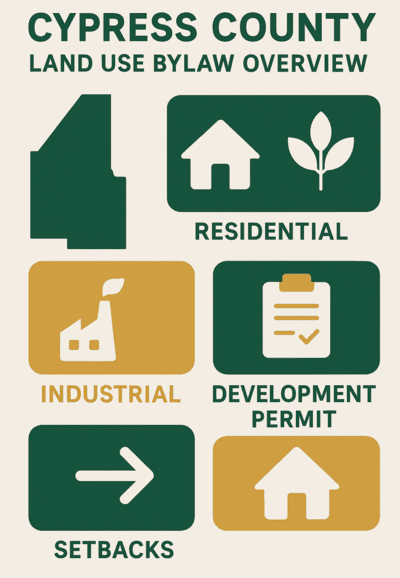
Buyer Due Diligence
Why the Land Use Bylaw Matters Before You Buy
If you are buying land, an acreage, a rural home, a farm parcel, or a property near Medicine Hat, the Cypress County Land Use Bylaw is one of the first documents to understand. It can affect where you build, whether you can add a shop, how a home-based business is treated, whether a use is allowed, and whether a development permit or reclassification is needed.
Rural Lifestyle
Freedom Has a Framework
Cypress County offers big-sky rural living, acreages, agricultural land, and space for practical outbuildings, but the permitted use of a parcel depends on its district and site conditions.
Purchase Risk
The Wrong Assumption Can Be Expensive
A property that looks ideal for animals, a shop, a second dwelling, a business, or subdivision may still need discretionary approval, reclassification, servicing review, or additional permits.
Buyer tip: The safest question is not just "What is the zoning?" It is "Does this specific parcel allow what I want to do, where I want to do it, with the buildings and services already in place?"
Planning Framework
How Cypress County Planning Works
Cypress County's planning information describes a broader framework that includes the South Saskatchewan Regional Plan, the County's Municipal Development Plan, the Land Use Bylaw, Area Structure Plans, intermunicipal development plans, and other planning tools. In plain language, the Land Use Bylaw is the day-to-day rulebook, but it does not sit alone.
Agriculture Comes First
The County's Municipal Development Plan recognizes agriculture as the primary land use in Cypress County. That matters when buyers are considering non-agricultural development, country residential uses, businesses, subdivision, or land near active farms and ranches.
Location Still Matters
A parcel may also be affected by road access, servicing, environmental features, adjacent land uses, highways, hamlets, irrigation works, and special planning areas such as intermunicipal development plan areas.
Land Use Districts
Common District Questions for Cypress County Buyers
The exact district must be confirmed with Cypress County for the parcel you are considering. District names and rules can change through amendment bylaws, and a property's district determines the list of permitted and discretionary uses.
| District or Area Type | Buyer Questions to Ask |
|---|---|
| Agricultural Areas | Is the parcel intended to remain agricultural? Are non-agricultural uses, second dwellings, businesses, or subdivisions restricted? |
| Country Residential or Acreage Areas | Are your planned uses residential only, or do you need approval for animals, a shop, accessory buildings, a suite, or a home business? |
| Hamlets and Residential Areas | Do hard surfacing, additions, garages, fences, accessory buildings, or use changes require a permit? |
| Commercial or Industrial Areas | Does the intended business match the district, and are access, parking, landscaping, signage, servicing, and buffering requirements addressed? |
| Direct Control Areas | Does the property have site-specific rules? Direct Control districts can be customized, so assumptions from nearby parcels may not apply. |
| Special Planning Areas | Is the parcel affected by an intermunicipal development plan, area structure plan, overlay, highway corridor, or environmental feature? |
Permitted vs. Discretionary
Allowed Uses Are Not All Treated the Same
The Land Use Bylaw separates uses into permitted and discretionary categories. A permitted use is usually more straightforward if the application meets all bylaw requirements. A discretionary use requires additional review and can be approved, approved with conditions, or refused depending on the details.
Permitted Use
More Predictable, Not Automatic
A permitted use may still need a development permit and must comply with applicable standards such as setbacks, parking, servicing, access, and site design.
Discretionary Use
More Review, More Conditions
A discretionary use may involve neighbours, the Municipal Planning Commission, conditions of approval, appeal periods, or refusal if the use does not fit the site.
Practical point: If your intended use is not listed in the district, or if it does not fit the current district, Cypress County may require a land use reclassification before a development permit can be considered.
Development Permits
Do You Need a Development Permit?
In many cases, yes. Cypress County's development information says development permits are needed for new construction, additions to buildings, accessory buildings, changes to how land or buildings are used, and hard surfacing in hamlets.
Common Permit Triggers
- New home, shop, garage, barn, or other building
- Additions or major exterior changes
- Accessory buildings and storage structures
- Changing the use of land or a building
- Hard surfacing in hamlet areas
- Commercial, industrial, or business-related use changes
Possible Exemptions
Cypress County notes that some farm buildings and developments may not require a development permit when they meet specific exemption criteria. Buyers should not rely on a general "farm exemption" without confirming the exact project and parcel with the County.
Safety Codes are separate: Cypress County notes that it does not administer provincial building codes. Depending on the project, you may still need building, electrical, gas, plumbing, private sewage, or other Safety Codes permits through an accredited agency or appropriate authority.
Application Process
Typical Development Permit Steps
| Step | What to Confirm |
|---|---|
| 1. Confirm the District | Ask Cypress County to confirm the current land use district for the exact legal parcel. |
| 2. Check the Proposed Use | Determine whether the use is permitted, discretionary, exempt, or not listed in that district. |
| 3. Review Reclassification | If the use does not fit the current district, ask whether land use reclassification is needed first. |
| 4. Prepare the Site Plan | Show property boundaries, building location, dimensions, access, and front, rear, and side yard setbacks. |
| 5. Submit the Application | Include the required form, fee, owner authorization if needed, and supporting documents. |
| 6. Wait for the Decision | Do not begin construction or use changes until approval is issued and any appeal period or conditions are understood. |
Setbacks and Site Standards
Setbacks: Why Exact Parcel Confirmation Matters
Setbacks are the minimum required distances between buildings or structures and property lines, roads, and other features. Cypress County's development permit materials require site plans to show front, rear, and side yard setbacks.
Do Not Guess Setbacks
Setback requirements can depend on the land use district, road classification, building type, parcel layout, adjacent uses, and special planning constraints. A generic number can be misleading.
Look Beyond Property Lines
- Road allowances, approaches, and highway access
- Utility rights-of-way and easements
- Irrigation infrastructure or drainage features
- Oil and gas infrastructure or pipeline corridors
- Water wells, septic systems, and future replacement areas
Buyer Checklist
What to Verify Before Making an Offer
| Due Diligence Item | Why It Matters |
|---|---|
| Current Land Use District | Controls the permitted and discretionary uses for the parcel. |
| Your Intended Use | Animals, shops, second dwellings, suites, business use, storage, and subdivision may all be treated differently. |
| Setbacks and Building Envelope | The legal building area may be smaller than the open land appears. |
| Development Permit History | Existing buildings and uses should be checked for available permits or approval history. |
| Safety Codes Permits | Electrical, gas, plumbing, building, and private sewage permits may matter for resale and insurance. |
| Title and Registered Interests | Easements, caveats, utility rights-of-way, and access agreements can limit future plans. |
| Water, Septic, and Utilities | Rural servicing can affect use, cost, financing, and future building options. |
| Neighbouring Land Uses | Active agriculture, industry, highways, or future planning areas can affect enjoyment and development potential. |
Reclassification
When Rezoning or Direct Control Becomes Part of the Conversation
If a buyer or owner wants to use land in a way that does not fit the current district, Cypress County may require a land use reclassification before a development permit can move forward. This is a bigger decision than a standard permit because it changes the district rules that apply to the parcel.
Higher Uncertainty
Reclassification Is Not Guaranteed
Rezoning can involve planning review, public process, council consideration, and compatibility with the County's statutory plans.
Site Specific
Direct Control Districts
Direct Control districts can apply custom rules to specific sites. That means two nearby properties may not have the same development options.
Official Cypress County Resources
Search Rural Southern Alberta
Helpful Alberta Town & Country Links
Use these related pages when comparing Cypress County land, acreages, farms, and rural properties across Southern Alberta.
Cypress County Acreages
Cypress County Homes
Medicine Hat Acreages
Southern Alberta Acreages
Southern Alberta Land
Southern Alberta Farms
Acreage Utilities
Septic and Well Checklist
Rural Real Estate FAQ
FAQ
Cypress County Land Use Bylaw FAQs
Common buyer questions about zoning, permits, reclassification, rural uses, and Cypress County property due diligence.
Start with Cypress County's maps and planning department, then confirm directly with the County using the legal land description or parcel address. Do not rely only on listing remarks.
No. Agriculture is the primary land use in Cypress County, but buildings, residences, businesses, subdivision, and non-agricultural uses can still be regulated by the Land Use Bylaw, statutory plans, permits, and Safety Codes requirements.
Often, yes. Cypress County lists accessory buildings among the types of development that require a development permit, although some exemptions may apply in specific circumstances. Confirm with the County before starting work.
A development permit deals with land use, location, setbacks, and whether the project fits the County's bylaw. Safety Codes permits deal with construction, electrical, gas, plumbing, private sewage, and similar technical requirements.
For rural land, acreages, farms, development land, or properties with future building plans, it is wise to discuss conditions with your real estate professional, lawyer, lender, inspector, and the County before removing conditions.
Cypress County Buyer Guidance
Buying Land or an Acreage in Cypress County?
Diane Richardson helps rural Alberta buyers look beyond the listing photos and understand whether the land, zoning, access, utilities, and existing improvements support the lifestyle and long-term plans they have in mind.
Phone: 403.397.3706 Email: Diane@mypadcalgary.com
Last updated: May 2026. This guide is for general buyer education only. It is not legal, planning, engineering, building-code, subdivision, tax, or permitting advice. Land use rules, statutory plans, amendment bylaws, forms, fees, and interpretations can change. Always verify current requirements directly with Cypress County, Alberta Safety Codes authorities, legal advisors, inspectors, utility providers, and other qualified professionals before purchasing property, applying for permits, or starting development.

CIR REALTY
Office
703 64 Ave SE #130
Calgary, AB, T2H 2C3